 Global Gateways
International Education Navigation Center
Kyushu University Global Professional Certificate Program
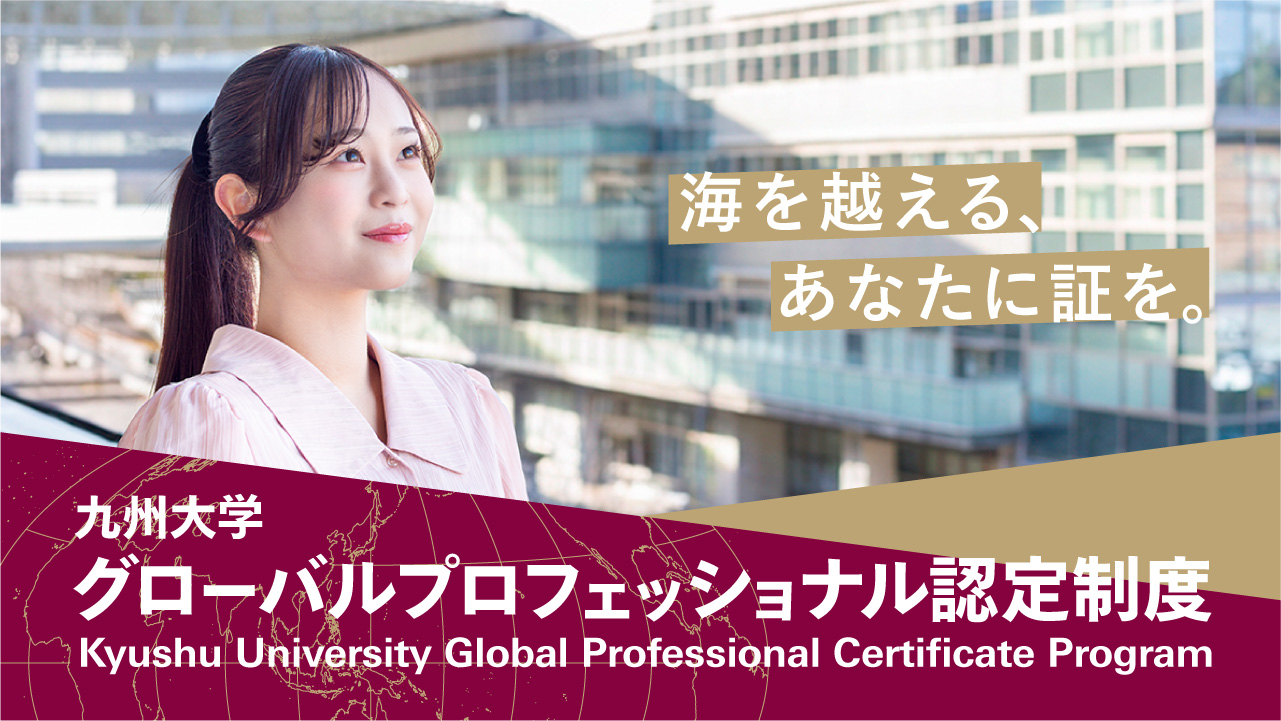
The Global Professional Certificate Program (グローバルプロフェッショナル認定制度) certifies students’ cross-cultural understanding, problem-solving skills, practical and global leadership strengths through study abroad and international activities. We offer a variety of pathways, including language learning, overseas opportunities, and hands-on activities.
The certification is issued as an open badge, serving as a powerful asset for career development and job hunting.
Learn from the world. Build your future. Take your next step.
For more details, please refer to the program guidelines and the course list below.
Global Professional Certificate Program Guidelines
List of Designated Courses
How to Join
Register for the Moodle site ‘グローバルプロフェッショナル認定制度/Global Professional Certificate Program’Moodle link: https://moodle.s.kyushu-u.ac.jp/course/view.php?id=68696
You can begin the program at any time during your undergraduate studies at Kyushu University.
Eligibility
Undergraduate students enrolled at Kyushu University from the 2026 academic year onward.Completion Requirements
To complete the Global Professional Certificate Program, students must fulfill the following six requirements and earn the designated credits:① Attend the program guidance session and submit a Learning Statement.
② Earn at least 2 credits from the Global Mindset Development Course Group (see Table 1).
③ Earn at least 2 credits from the Global Communication Skills Development Course Group (see Table 2), and obtain the required score in one of the English proficiency tests designated by the program.
Required English proficiency scores
TOEFL iBT: 72 (New Scale: 4), EIKEN Grade Pre-1, IELTS: 5.5, TOEIC (Listening & Reading): 785, TOEFL ITP: 543,
DET (Duolingo English Test) 100
Note: Students enrolled in International Undergraduate Programs in English (IUPE) such as those in the School of Agriculture,
School of Engineering, and School of Interdisciplinary Science and Innovation for October admission are exempt from submitting English
proficiency scoresfor this requirement.
④ Participate in Kyushu University’s medium- or long-term study abroad (91 days or more), or short-term/online study abroad programs, and earn at least 4 credits. If fewer than 4 credits are earned, supplement with courses from the Overseas Challenge Course Group (see Table 3).
*For Bronze Certificate, requirement ④ is not mandatory.
⑤ Complete at least one practical activity from the designated options and submit the required information on the designated form together with the final report.
⑥ Submit a final report along with the required course records and supporting documents.
Note: For more information about the courses, please see the List of Designated Courses provided above.
Flow from Enrollment to Completion
Step 1. Start of the Global Professional Certificate ProgramStudents can start at any time during their enrollment in an undergraduate program at Kyushu University. First, watch the certificate program guidance video below and register for the Global Professional Certificate Program’s Moodle. Submit your “Learning Statement” to Moodle to get started.
Step 2. Course Enrollment
There is no fixed order for completing the program components. For course registration, including those offered by KIKAN Education (General Education) or individual faculties, students should refer to the course syllabi, faculty websites, and registration guidelines.
Note: Courses offered as intensive lectures may have different registration periods than regular courses.
Step 3. Certification of Completion
Once requirements ① through ⑤ are fulfilled, students must submit a final report (⑥) reflecting on their learning and future outlook to the Global Professional Certificate Program’s Moodle. Upon approval, they will be awarded the Global Professional Certificate.
Certification reviews are conducted in the first and second semesters (applications due by the end of May and the end of October), and certificates are issued in August for the spring semester and in February for the fall semester. Certificates are issued as Open Badges.
Guidance Videos
This video clearly explains the program overview, experiences of seniors who studied abroad, and how to write your learning statement. All participants in the Global Professional Certificate Program must watch it.●Program Purpose
●Program Overview, How to Register for Moodle, and How to Write Your Learning Statement
● Experiences of Seniors Who Studied Abroad
Certification Types
The program offers three levels of certification based on the degree of completion. The certificate will be awarded as an Open Badge under the Minor Program. Please note that only one type of certificate can be obtained during enrollment. It is not possible to obtain multiple types of certificates or to upgrade to a higher-level certificate after obtaining one (e.g., applying to upgrade from Bronze to Silver).Gold
| 12 credits + | ・Learning Statement |
| ・Study abroad experience of 91 days or more | |
| ・English proficiency test score | |
| ・Record of practical activities | |
| ・Final report |
Silver
| 8 credits + | ・Learning Statement |
| ・Short-term study abroad or online study programs | |
| ・English proficiency test score | |
| ・Record of practical activities | |
| ・Final report |
Bronze
| 4 credits + | ・Learning Statement |
| ・English proficiency test score | |
| ・Record of practical activities | |
| ・Final report |
Navigate the Globe
Navigate the Globe is your all-in-one guide to Kyushu University’s international programs, designed to help you expand your horizons during your university years. Search for exchange programs, short-term study abroad opportunities, and online learning programs based on your school or areas of interest. Participate in programs to earn Gold or Silver Open Badges.Navigate the Globe
https://navigateglobe.kyushu-u.ac.jp/en
FAQ
Program Overview
-
The language skills, study‑abroad experience, practical activities, and other learning you gain through this program are formally recognized as part of the university’s minor program. In particular, the title “Certified Global Professional” becomes a strong advantage for your résumé and career development and serves as a powerful point of appeal when applying for jobs both in Japan and abroad, as well as when applying to graduate school. Many master’s programs evaluate English proficiency through the submission of external test scores. Participating in the Global Professional Certificate Program directly contributes to improving your English test scores. In addition, the experiences you gain through the program help demonstrate your critical thinking, proactiveness, and interpersonal skills—assets that are highly valuable for succeeding in graduate‑level research. Since many laboratories conduct research together with international students, the global experience you acquire here will also support effective collaboration with them.
Furthermore, the program offers opportunities to expand your network through practical activities and events on campus, allowing you to connect with peers across different schools and year levels. Working together with fellow participants, sharing information, and collaborating on various challenges are major benefits of the program.
Through the Global Professional Certificate Program, broaden your connections and expand your possibilities for the future!
-
You can start the program at any time while you are enrolled as an undergraduate student. The English courses you take in your first year also count as eligible courses for the program. After enrolling at the university, start by registering for the Global Professional Certificate Program on Moodle and watching the guidance video.
-
Yes. As long as you are enrolled as an undergraduate student, you may start the program at any time, and credits or activities completed in earlier years can be counted.
-
There are two certification periods each year: at the end of May and at the end of October. If you apply at the end of May, the open badge will be issued in August. If you apply at the end of October, the open badge will be issued in February.
-
You cannot receive the certification after graduating from the undergraduate program, so please aim to complete it while you are still enrolled. Since issuing the Open Badge takes about three to four months, be sure to plan ahead and complete the requirements well before graduation.
-
No, there is no required order. You may take the courses in any sequence you prefer.
-
Students who enroll in the 2026 academic year and later are eligible for the program. Students who enrolled in years earlier than the designated eligibility year are not eligible for the program.
-
Because this program is intended for undergraduate students, graduate students are not eligible to register.
-
Participation in the Global Professional Certificate Program is free of charge. However, expenses related to studying abroad or taking external language proficiency tests must be covered individually.
-
No. Nothing such as a failing grade will appear on your transcript. This program is designed to recognize your efforts, so please feel free to challenge yourself without fear of failure.
Program Details
-
The orientation is explained in the first‑year course Academic English: Interaction within the KIKAN Education curriculum. You can also watch the guidance video on the Global Professional Certificate Program Moodle page: Moodle.
-
The Global Professional Certificate Program begins with writing a Learning Statement. A Learning Statement is a short piece of writing (about 200–300 characters in Japanese/100 words in English) in which you describe the types of international learning experiences you hope to pursue during your studies and the reasons for your interest. Writing this statement helps you clarify your goals and serves as a guide when choosing what to learn and experience through the program.
For details on how to write a Learning Statement, please refer to the Global Professional Certificate Program Moodle page:Moodle.
-
It refers to online programs offered by overseas universities with which Kyushu University has established exchange agreements and for which academic credits are recognized by Kyushu University. For example, credits earned through online courses provided by partner universities abroad or virtual exchange programs offered by the APRU (Association of Pacific Rim Universities) are eligible.
-
A mid- to long-term study abroad program requires a stay of 91 days or longer. Participation in multiple short-term programs cannot be combined to reach the 91-day requirement. To qualify for the Gold Certificate, the requirement of 91 days or more must be met within a single program.
-
Recognized study abroad includes mid- to long-term programs (91 days or longer) and short-term or online programs organized by Kyushu University (including its undergraduate schools and graduate schools). Programs or activities organized by overseas universities or external institutions are also considered study abroad if they are approved for academic credit by Kyushu University or its schools. However, presenting at or participating in international conferences or symposia is not recognized as study abroad.
If any of these study abroad experiences do not award academic credits, students must take courses from the Overseas Challenge Course Group to make up for the missing credits.
-
If the study abroad program you participated in does not award academic credit, you can fulfill the requirement by taking courses from the Overseas Challenge Course Group and earning the necessary credits to make up for the shortfall.
-
You can meet the requirement by taking courses from the Overseas Challenge Course Group and earning the necessary credits to make up for the shortfall.
-
In this context, “online study abroad” refers to learning activities conducted in an international collaborative environment by connecting online with overseas universities or educational institutions. Programs are recognized as online study abroad under the Overseas Challenge Program only when they are approved for academic credit by Kyushu University or its schools.
-
These are activities in which students make use of the learning and experiences gained through study abroad or other international experiences to contribute to the internationalization of the university and the local community. The activities recognized under this program are listed in the program guidelines. Choose one or more from the approved options and put them into practice. Paid activities are also accepted.
-
Whether third-party verification is required depends on the type of activity. Please download the designated form from Moodle and submit it as instructed.
Credits
-
To obtain the Gold Open Badge, you must earn a total of 12 credits. After fulfilling all the required components, any remaining credits needed to reach 12 may be combined from any of the programs.
Credit requirements and completion criteria
-Global Mindset Development Program: Earn 2 credits or more.
-Global Communication Skills Development Program: Earn 2 credits or more, plus obtain the required score on an English proficiency test designated by this certification system.
-Overseas Challenge Program: Participate in a Kyushu University mid- to long-term study abroad program (91 days or longer), or a short-term or online study abroad program, and earn 4 credits or more.
-Practical Activity Program: Complete at least one approved activity and submit documents that verify your participation.
Example
Global Mindset Development Program: 3 credits
Global Communication Skills Development Program: 3 credits + required English proficiency test score
Overseas Challenge Program: 6 credits (from a long-term study abroad program)
Practical Activity Program: submitted activity verification documents
→ Total: 12 credits, so you are eligible to apply for the Gold Open Badge.
-
Yes. Credits earned through the Global Professional Certificate Program can also be counted toward other Minor Certificate Programs or graduation requirements.
English Proficiency Score
-
You must obtain a score that meets or exceeds the standards listed below on one of the English proficiency tests designated by this certificate program:
TOEFL iBT: 72 (new scoring system: 4)
EIKEN Test in Practical English Proficiency: Pre–Level 1
IELTS 5.5
TOEIC (L & R) 785
TOEFL ITP 543
DET (Duolingo English Test) 100
-
There is no restriction on when the score was obtained. Scores earned in the past are also valid.
-
Yes. All applicants are required to submit proof of English proficiency in order to receive certification. However, students enrolled in the International Undergraduate Program in English (IUPE) in the School of Agriculture or the School of Engineering, as well as students in the School of Interdisciplinary Science and Innovation who enrolled in October, are exempt from submitting an English proficiency score.
Open Badges
-
An Open Badge is a digital credential issued based on international standards to certify an individual’s knowledge and skills. Kyushu University is a member of the Open Badge Network Foundation and issues badges compliant with the latest “Open Badge 3.0” standard.
Open Badges can be used as an objective way to demonstrate various skills and learning achievements, such as qualifications, completion of training programs, and project outcomes. Recipients can easily share and verify their badges by displaying them in email signatures, on social media, or in résumés for job applications and career development.
For more details, please refer to “Kyushu University Open Badge”:
https://www.kyushu-u.ac.jp/en/faculty/class/openbadge
-
There are three types of Open Badges: Gold, Silver, and Bronze. Each badge has different credit requirements and completion criteria, so please check the program guidelines for details.
-
No. Within this program, you may obtain only one Open Badge once during your enrollment. It is not possible to earn multiple badges of different types, nor can you upgrade to a higher-level badge after obtaining one (for example, applying to change from Bronze to Silver). Please consider carefully which badge you wish to pursue before submitting your application.
-
No. Once you have submitted your Open Badge application, it cannot be withdrawn. Since you may earn an Open Badge under this program only once during your enrollment, please make sure to review all requirements carefully before submitting your application.
-
No, there is no cost.
For Students Enrolled Before Academic Year 2026
-
No. The program is open only to undergraduate students who enroll in or after Academic Year 2026. Students who enrolled before Academic Year 2026 are not eligible to participate.
Contact
International Education Navigation Center, Kyushu Universityinavi@jimu.kyushu-u.ac.jp
If you’d like more information or are unsure whether this program is right for you, our faculty members and staff are here to help. Please feel free to contact us by email first.
Study Abroad Information Website “Navigate the Globe”
Navigate the Globe is a comprehensive study abroad information platform operated by Kyushu University’s International Education Navigation Center. Beyond university-wide programs, we showcase unique international research and educational opportunities across various fields. This site serves as a central resource for students—whether they are exploring study abroad options, preparing for departure, or returning from their international experience.Our mission is to present Kyushu University’s diverse study abroad programs and international exchange initiatives in an accessible, systematic format that puts students’ needs first. We guide students through their journey of global engagement, whether through study abroad or international programs at Kyushu University.
Navigate the Globe

About the Center
Kyushu University, in line with its VISION 2030 to become a university that drives social transformation through comprehensive knowledge, has set forth the goals of “cultivating value-creating individuals who can thrive globally” and “nurturing leaders for the international community by becoming a hub for international brain circulation through global collaboration.” Additionally, our fourth mid-term objectives include “expanding the acceptance of outstanding international students and increasing diverse overseas dispatches of students in conjunction with education and research,” “creating new international collaboration projects with leading overseas universities to strengthen our international research and educational capabilities,” and “promoting the internationalization of our campus.”
To achieve these goals, we established the International Education Navigation Center (iNavi) on April 1, 2024, with the purpose of centralizing information related to international education both within and outside the university, providing seamless international education navigation, and offering recommendations to the executive board for the formulation of our international strategy. The center also aims to promote and support the internationalization of education within various faculties.
As a think tank and do tank, the center will timely share the rich experience and knowledge related to international education accumulated by various schools, graduate schools, and centers, as well as the latest trends in international education both domestically and internationally, across the entire university. This will enable the integrated expansion of both inbound and outbound programs for students, systematically producing “excellent global value-creating individuals,” including outstanding international students and Japanese students with a global mindset. Furthermore, these efforts will be extended to other universities in Japan, contributing to the realization of the study abroad dispatch and acceptance goals emphasized by J-MIRAI, Japan’s initiative to promote study abroad for young people who create the future, which focuses on improving quality.
Specifically, to effectively utilize the university’s internal resources for international education, the center will centrally consolidate information related to the achievements and experiences of various schools and graduate schools in international education, as well as various initiatives related to creating an environment that realizes campus internationalization. Additionally, existing educational programs and know-how implemented by one faculty will be horizontally expanded and connected to other faculties. Moreover, the center will provide comprehensive academic navigation and various support services to students and international students, overseeing their journey from pre-admission through their studies, and even after graduation, while building networks throughout their paths.
Director
Senior Vice President
Mako Nakamura
Faculty Profiles
Data & Resource Coordination Division
Professor
Yasuaki Hiromasa
Faculty Profiles
Program Design & Development Division
Professor
Takako Suzuki
Faculty Profiles
Educational Navigation Division
Associate Professor
Moe Shimomura
Faculty Profiles
Activity Report
Activity Report 2025Contact & Map
International Education Navigation CenterEB-530, East Zone 1, 744 Motooka Nishi-ku Fukuoka 819-0395, Japan
Email: ien.center [at] jimu.kyushu-u.ac.jp
Please come to Building No. 84 on the Campus Map (Ito).
Access Map